AI Agents · July 10, 2025 · 1 min read
Research Support AI: Document Intelligence Platform
The Problem
Researchers often work with hundreds of documents, reports, PDFs, and academic papers at the same time. Reading everything manually takes weeks, and finding specific information across multiple files becomes increasingly difficult as datasets grow.
For international research teams, this process slows down decision-making and consumes valuable time that could be spent on actual analysis.
The Solution
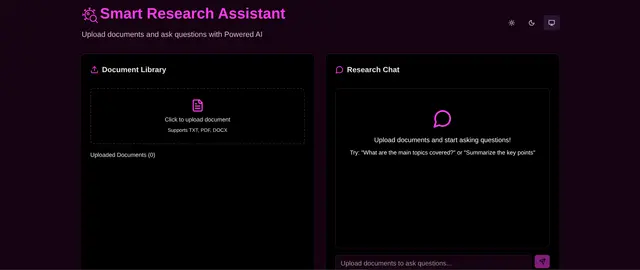
I built Research Support AI, a document intelligence platform that allows researchers to upload large collections of documents and interact with them through natural language.
Instead of manually searching through files, users can ask questions, generate summaries, compare findings, and extract insights instantly.
Key Features
- Bulk Document Uploads: Process hundreds of PDFs and documents in a single workspace.
- AI-Powered Search: Ask questions in plain English and receive answers grounded in uploaded documents.
- Cross-Document Analysis: Compare findings and identify patterns across multiple sources.
- Automatic Summarization: Generate concise summaries for long reports and research papers.
- Context-Aware Responses: Uses document retrieval techniques to provide accurate, source-based answers.
- Research Workflow Optimization: Reduces time spent reading and searching through large datasets.
Technical Implementation
The platform is built with Next.js, TypeScript, Shadcn UI, and Tailwind CSS on the frontend, combined with AI-powered document processing and retrieval systems.
Documents are indexed, embedded, and made searchable through semantic search techniques, allowing users to retrieve relevant information even when exact keywords are not present.
Impact
Research teams using the platform can reduce document review time from days to minutes. Instead of manually scanning hundreds of pages, researchers can focus on interpreting results, validating findings, and making informed decisions.
The result is faster research cycles, improved productivity, and easier access to knowledge hidden across large collections of documents.